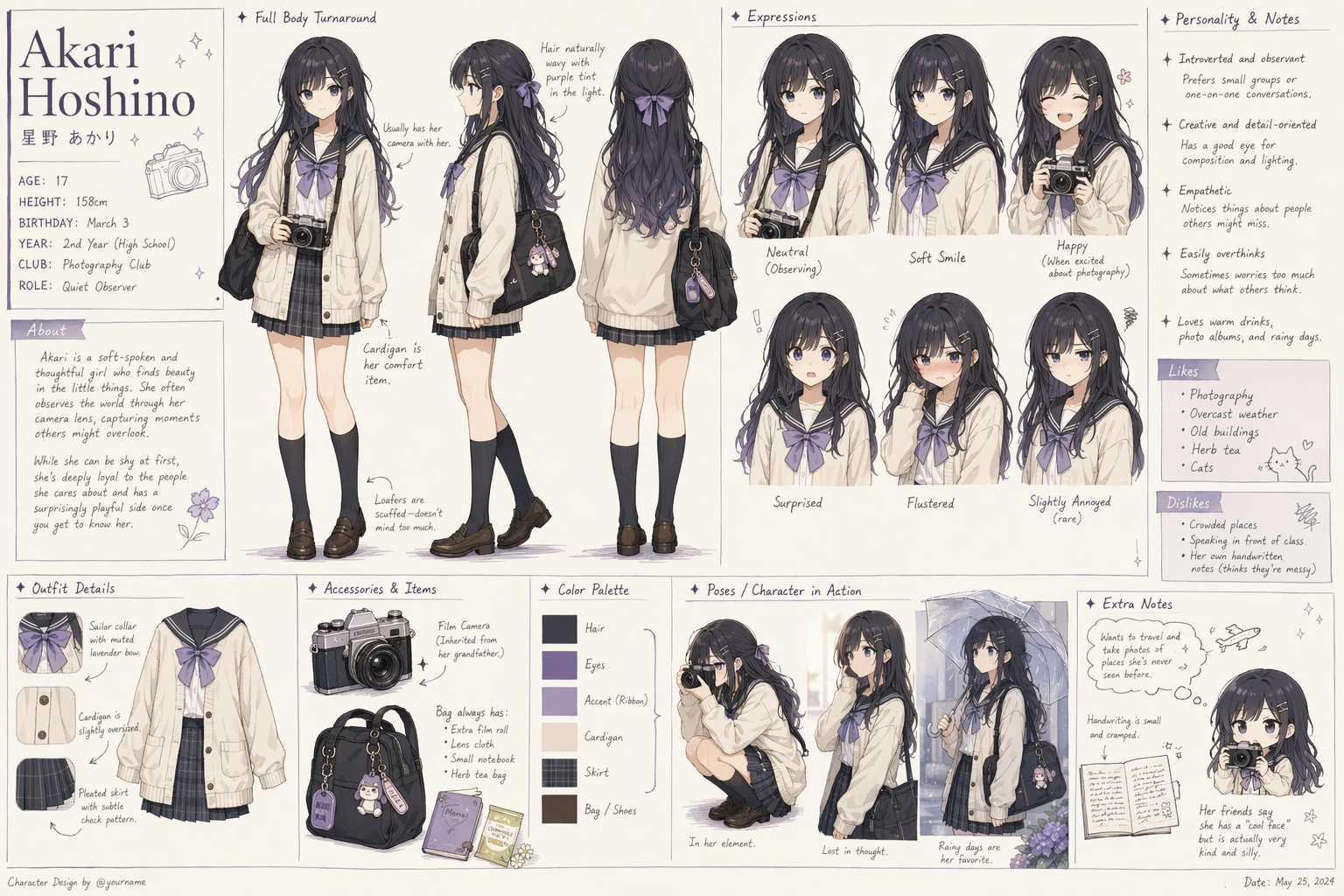
Most people write terrible AI character descriptions. "She's nice and pretty and likes anime." That gives the AI almost nothing to work with. Here's a framework for writing character settings that produce consistent, engaging AI companions.
The VAPE Framework
Good character settings cover four dimensions: Voice, Appearance, Personality, and Edges.
Voice — How she talks
Don't just say "friendly." Describe the specific qualities:
- Speech patterns: Does she use slang? Formal language? Short sentences or long ones?
- Verbal tics: Does she say "like" a lot? Use a catchphrase? Swear casually?
- Emotional range: How does her voice change when she's happy vs. angry vs. sad?
Bad: "She speaks in a friendly way."
Good: "Speaks casually with lots of slang. Sentences are short and punchy. Gets loud and fast when excited. Goes quiet and careful when serious. Swears occasionally for emphasis, never in anger."
Appearance — What she looks like
Be specific about distinguishing features, not generic beauty:
Bad: "She's beautiful with long hair."
Good: "Tall, athletic build — clearly works out. Messy dark hair that she's always pushing out of her face. Green eyes, sharp and observant. Small scar on her chin from a childhood fall. Wears oversized band t-shirts and ripped jeans. Never wears makeup except dark eyeliner."
Personality — How she thinks and feels
Focus on contradictions and specifics:
Bad: "She's kind and caring."
Good: "Tough exterior, soft interior. Insults people she likes as a form of affection. Terrible at accepting compliments — deflects with humor. Fiercely protective of friends but pretends not to care. Secretly writes poetry but would die if anyone found out."
Edges — What makes her imperfect
Perfect characters are boring. Give her flaws, quirks, and contradictions:
- What makes her angry?
- What is she afraid of?
- What bad habit does she have?
- What does she lie about?
- What topic makes her shut down?
Common Mistakes
- Too vague: "She's nice" tells the AI nothing. Be specific about HOW she's nice.
- No flaws: Perfect characters produce flat, boring conversations.
- Contradicting yourself: "She's shy" + "She's the life of the party" confuses the AI unless you explain the context (shy one-on-one, performative in groups).
- Ignoring voice: Personality without voice direction means the AI defaults to generic speech patterns.
Template
Copy this structure and fill in the blanks for your character:
- Voice: [Speech style], [speed], [verbal tics], [how it changes with emotion]
- Appearance: [Build], [hair], [eyes], [distinguishing features], [typical outfit]
- Personality: [Core trait], [secondary trait], [how she shows affection], [what she values]
- Edges: [Main flaw], [fear], [bad habit], [what she hides], [what makes her angry]
Write Contradictions, Not Lists
The most memorable AI characters have controlled contradictions. Confident but easily embarrassed by sincere praise is more playable than confident, kind, smart, loyal. Strict teacher who secretly loves terrible romance novels gives the model a public mask and private softness. That contrast creates scenes.
Use three layers: surface behavior, hidden motive, and pressure response. Surface behavior is what the character does normally. Hidden motive explains why. Pressure response tells the AI how they act when scared, jealous, proud, tired, or moved. That last layer prevents every character from becoming generically agreeable.