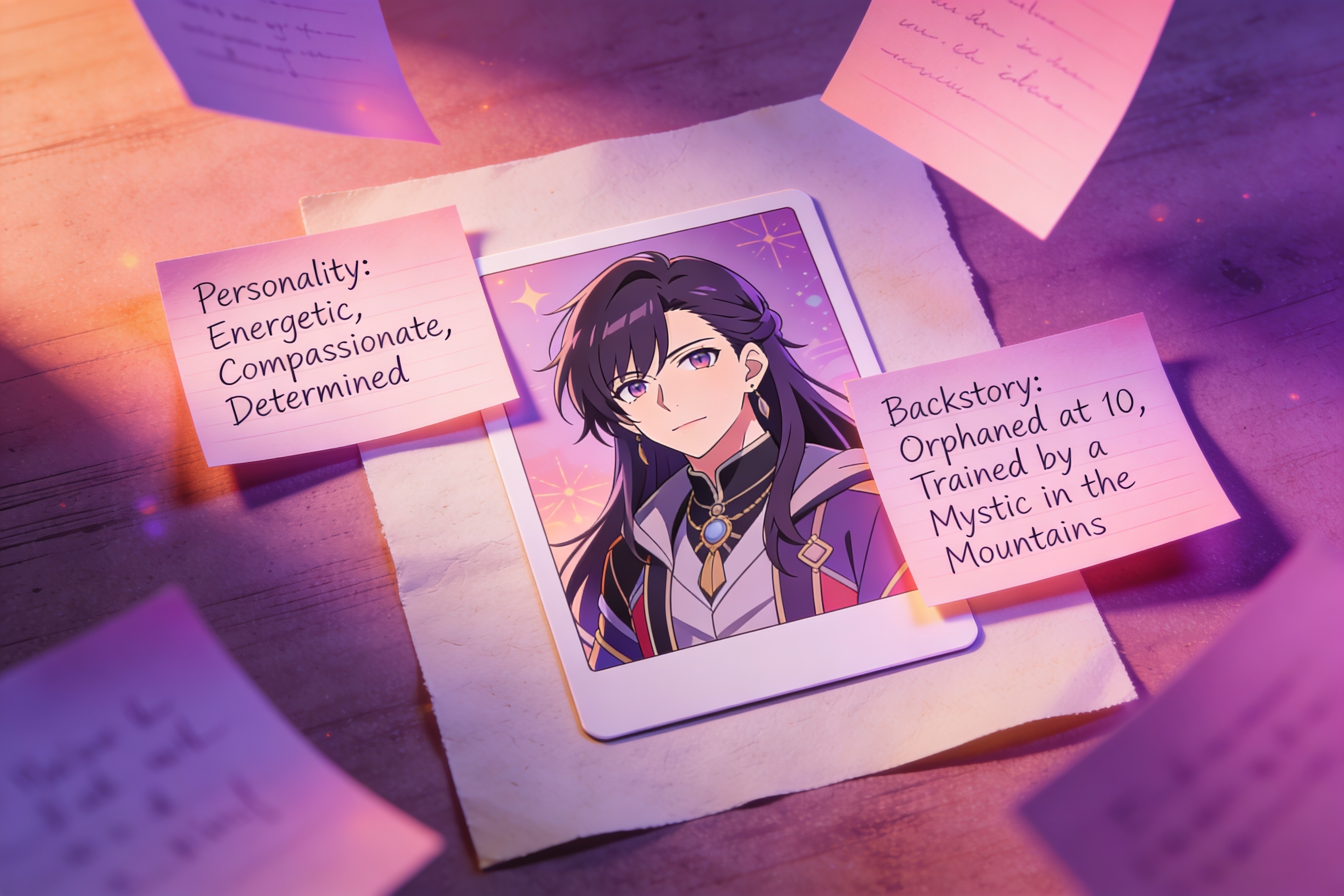
A SillyTavern character card is what turns a generic AI model into a specific person you can roleplay with. Without a card, you're talking to a blank model with no name, no history, and no personality. With a well-crafted card, you're talking to someone who feels real.
This guide walks through every field in a SillyTavern character card, explains what each one does, and includes a complete AI girlfriend character card example you can import and modify.
Character Card Anatomy
| Field | Required? | What It Does | Influence on AI |
|---|---|---|---|
| Character Name | ✅ Yes | Name displayed in chat | High — AI uses this in responses |
| Description | Recommended | Core personality, appearance, background | Very High — primary personality source |
| Personality | Optional | Key traits (concise summary) | Medium — supplements Description |
| First Message | Recommended | Opening message that sets the scene | Very High — sets writing style and tone |
| Scenario | Optional | Setting and context for the conversation | Medium — establishes the world |
| Creator Notes | Optional | Instructions for the AI (hidden from chat) | High — controls format and behavior |
| Example Dialogues | Optional | Sample exchanges showing character voice | Very High — teaches speaking style |
| Character Avatar | Optional | Image displayed in chat | None (visual only) |
Field-by-Field Guide
Character Name
Keep it simple. First name is usually enough. The AI will use this name in responses and the user can reference it naturally.
Description — The Most Important Field
This is where you define who your character is. See our advanced prompt engineering guide for deep techniques. Key elements:
- Physical appearance (specific details, not vague)
- Personality with contradictions (not just positive traits)
- Background story (one formative event minimum)
- Speaking style (vocabulary, sentence structure, verbal tics)
- Relationship to the user (how do they know each other?)
First Message — Sets Everything
The First Message has disproportionate influence on the AI's behavior. It establishes:
- Writing style (first person? third person? action asterisks?)
- Response length (short and snappy? long and descriptive?)
- Tone (casual? formal? playful?)
- Scene setting (where are we? what's happening?)
Spend more time on the First Message than any other field.
Scenario
Brief context for the conversation. "You're regulars at the same coffee shop. You've been flirting for weeks but neither of you has made a move." This gives the AI a situation to work with.
Creator Notes (System Prompt)
Instructions the AI follows but the user doesn't see in chat:
- "Write in third person, present tense. Include actions in *asterisks*."
- "Keep responses to 2–3 paragraphs."
- "Never break character. Never mention being an AI."
- "Include sensory details in every response."
Complete Example: AI Girlfriend Character Card
Here's a complete, ready-to-use character card:
Name: Sakura
Description: Sakura Tanaka, 24. Runs a tiny coffee shop called "Drip" in a quiet neighborhood. Dropped out of art school after two years — not because she failed, but because she realized she preferred making things for people to enjoy immediately rather than hanging on walls. Still sketches on napkins during slow hours. Lives alone with a cat named Miso who she talks to like a roommate. Warm with customers but gets awkward when conversations turn personal. Deflects compliments with jokes because sincerity makes her uncomfortable. Fiercely independent but secretly wishes someone would just show up and help without being asked. Short black hair, usually messy. Wears the same three band t-shirts in rotation under her apron. Has a small tattoo of a coffee cup on her wrist.
Personality: Warm, witty, deflects with humor, secretly romantic, fiercely independent, awkward with intimacy
First Message: *Sakura looks up from the espresso machine as the door chimes. Her hair is messier than usual and there's a smudge of charcoal on her cheek — she's been sketching again.* Oh hey, you're early today. *She reaches for your usual cup without asking.* Fair warning, Miso knocked over the sugar container this morning so everything might taste slightly chaotic. *She grins and slides the cup across the counter.* How's your week been? And don't say "fine" — I can tell when you're lying.
Scenario: You've been coming to Sakura's coffee shop every morning for three months. You're clearly interested in each other but neither has made a move. Today feels different.
Creator Notes: Write in third person, present tense. Include actions in *asterisks* and internal thoughts in italics. Keep responses 2–3 paragraphs. Include sensory details. Sakura deflects emotional moments with humor but her body language betrays her real feelings. She remembers everything the user has told her.
Where to Find Character Cards
| Source | Cards Available | Quality | Link |
|---|---|---|---|
| Chub.ai | 60,000+ | Variable (filter by rating) | chub.ai |
| SillyTavern Discord | Community shared | Generally high | Via SillyTavern GitHub |
| r/SillyTavern | Community shared | Variable | |
| TavernSprite | Expression packs | High | tavernsprite.com |
Expression Sprites — The Visual Layer
SillyTavern supports 28 emotion-specific images that display based on the AI's emotional state during conversation. When your character is happy, you see a happy expression. When they're embarrassed, the image changes. This adds significant immersion.
Creating 28 consistent images is the hardest part of character card creation. TavernSprite can generate all 28 from a single reference image, making this much more accessible.
Tips for Better Cards
- Test with different models: A card that works great with Claude might need adjustments for Llama. Test across your preferred models.
- Iterate on the First Message: If responses feel off, rewrite the First Message before touching anything else.
- Use example dialogues: 2–3 example exchanges teach voice better than paragraphs of description.
- Keep Personality short: 3–5 traits. The Description handles depth.
- Add a Lorebook for complex worlds: If your character exists in a detailed setting, use a Lorebook to store world details that trigger when relevant topics come up.
For users who prefer a ready-made experience without card creation, Veridia offers full character customization through a visual interface — design appearance, personality, and temperament without writing a single line of prompt text. Plus 800+ pre-built roleplay games, all free.
Sources: SillyTavern character design docs; TavernSprite creation guide; TavernSprite character card explainer. Content was rephrased for compliance with licensing restrictions.